Can China’s top ten laser tattoo removal machines erase ink without leaving lasting marks? That question matters more than glossy specifications. Many readers ask, “does laser tattoo removal leave a permanent scar?” The honest answer is not always simple. Modern Q-switched and picosecond lasers can break tattoo pigment into smaller particles. The body then clears them gradually. However, results depend on wavelength, energy settings, tattoo depth, skin tone, ink color, and healing behavior.
Dr. Will Kirby, a board-certified dermatologist and tattoo-removal specialist, has emphasized, “The risk of scarring is low when treatment is performed properly.” That statement deserves context. Low risk does not mean zero risk. Excessive energy may cause blistering, prolonged redness, texture changes, or pigment shifts. Poor aftercare can also complicate healing. Sometimes, the tattoo fades unevenly.
This guide compares ten widely discussed Chinese laser tattoo removal machines through a practical, safety-focused lens. It considers pulse technology, cooling systems, wavelength options, operator controls, maintenance, and clinical support. A machine is only one part of the outcome. Training matters. Skin assessment matters more.
Look closely at real treatment details. A safe session should include protective eyewear, test spots, clear aftercare instructions, and realistic treatment intervals. Freshly treated skin may feel hot, like a mild sunburn. That sensation usually settles. Yet unusual pain, spreading redness, or thickened skin requires professional evaluation. No responsible review can promise scar-free results. Even experienced practitioners can misjudge a difficult tattoo. That uncertainty should remain visible when choosing equipment or treatment.
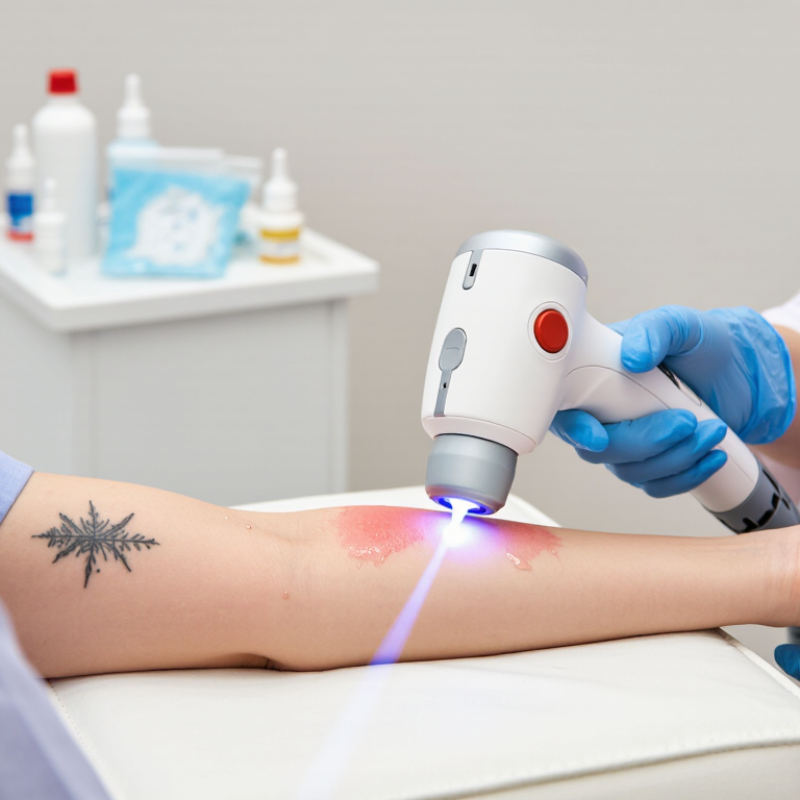
Laser tattoo removal machines work by delivering brief, high-energy pulses into unwanted ink. Specific wavelengths target different pigment colors. The energy breaks ink particles into smaller fragments through heat and rapid pressure changes. The body’s immune system then gradually carries these fragments away.
The ink does not simply vanish. Several sessions are usually needed, often spaced weeks apart. Black ink may respond more consistently than green, blue, or pale pigments. Results depend on ink depth, color, age, skin tone, and the device’s settings. A trained medical practitioner should assess these factors before treatment, especially on darker skin.
Can the process scar? It can, but permanent scarring is not expected when suitable equipment and careful settings are used. Excessive energy may cause burns, texture changes, or light and dark patches. Picking blisters increases risk. Sun exposure can also worsen pigment changes. A small test spot is sensible, though not perfect. Even experienced practitioners cannot predict every response. After treatment, gentle cleansing, sun protection, and proper aftercare support safer healing. Fresh skin needs time.
China’s Top 10 Laser Tattoo Removal Machines should be judged by performance, not appearance. A useful shortlist includes Q-switched Nd:YAG and picosecond systems, usually offering 1064 nm and 532 nm wavelengths. These settings target darker and some brighter pigments differently. Pulse width, spot size, cooling, and stable energy delivery matter more than impressive screen displays.
Do they scar? Not automatically. The operator’s settings, skin type, tattoo depth, and treatment spacing strongly influence risk. The American Academy of Dermatology reports that many tattoos require six to ten sessions, often separated by several weeks. The U.S. FDA also warns that complete removal is not guaranteed, especially with mixed pigments. A 2023 review in Lasers in Medical Science found temporary redness, swelling, and pigment changes were reported more often than permanent scarring. That difference matters.
For China’s top ten machines, buyers should request pulse-energy tests, maintenance records, cooling specifications, and clinical photographs under consistent lighting. A cautious provider should perform a small test spot first, particularly on darker skin. Over-treatment can cause blistering or lasting pigment loss. Cheap equipment is not always unsafe, but vague specifications deserve skepticism. I would not treat “picosecond” as proof of superior safety. It is only one technical feature. A ranking can still mislead when training and aftercare are ignored.
China’s Top 10 Laser Tattoo Removal Machines: Do They Scar?
Different laser types target tattoo pigments through selective photothermolysis. The wavelength matters because each ink color absorbs light differently. A 1064-nanometer laser usually targets black and dark-blue pigments. A 532-nanometer setting is more suitable for red, orange, and some yellow tones. Green and blue inks may respond better to 755 or 694 nanometers. Mixed-color tattoos often require several wavelengths.
Pulse duration also changes the result. Nanosecond devices deliver strong energy, while picosecond systems use shorter pulses to fracture pigment into smaller particles. A 2022 review in Lasers in Medical Science reported that tattoo clearance commonly requires multiple sessions, often six to ten, with intervals allowing the skin to recover. Results vary. They really do.
Scarring is not an automatic result of laser removal. However, excessive energy, poor cooling, active tanning, or incorrect wavelength selection can increase blistering and texture changes. The American Society for Laser Medicine and Surgery advises careful assessment, realistic expectations, and qualified operation. Clinical studies of the Kirby-Desai scale also show that ink density, color, location, and skin type affect treatment difficulty. In practice, temporary whitening, redness, swelling, or crusting may appear after treatment. A cautious test spot is useful, although it cannot predict everything. Some pigment colors respond unevenly, and faint shadows may remain.
Do laser tattoo removal machines cause scarring? Usually, properly selected treatment does not create permanent scars. However, the risk is real when energy settings are too aggressive or healing is disturbed. Skin may swell, blister, crust, or darken for several days. These reactions are not automatically scars. Scarring develops when deeper tissue is injured.
That distinction matters. An experienced, licensed provider should assess ink depth, color, skin tone, tattoo location, and previous scars before treatment. Dark or recently tanned skin may require conservative settings and longer intervals. Cooling, eye protection, sterile technique, and careful aftercare reduce avoidable complications. Do not pick blisters or remove crusts. Keep the area clean and protected from direct sunlight. Follow written aftercare instructions. Patch testing may reveal an unexpected response, but it cannot guarantee scar-free healing.
A list of China’s top ten laser tattoo removal machines cannot predict your personal safety. A ranking is not clinical evidence. Pulse width, wavelength, fluence, operator training, and individual biology all influence results. Some people develop temporary color changes; others may experience raised or depressed scars. Seek medical review if redness spreads, pain worsens, pus appears, or healing stalls. Photographs and treatment records can help a qualified clinician adjust later sessions. No device makes a universal promise。
China Top 10 Laser Tattoo Removal Machines: Do They Scar?
Choosing a safe laser machine matters more than choosing the newest model. Scarring is uncommon when trained professionals use correct settings, but risk increases with excessive energy, repeated passes, or poor cooling. The device should offer suitable wavelengths for different ink colours and adjustable pulse duration. Skin tone, tattoo depth, and ink density must guide every treatment.
Look for clear technical records, electrical safety documentation, reliable handpiece performance, and responsive maintenance support. A test spot should be performed before treating a larger area. Watch the skin closely. Mild whitening, redness, or swelling can occur after a pulse, while blistering or prolonged pain requires professional assessment. Proper eye protection is essential for everyone in the treatment room.
Do not judge a machine by advertising images alone. A lower price may hide unstable energy output or limited training support. Ask whether operators receive practical instruction, not just a certificate. Cooling equipment, emergency procedures, and clear aftercare guidance also matter. In real treatment settings, even a capable machine can produce poor results when settings are copied blindly. That is an easy mistake to make. Selective wavelengths, accurate calibration, and patient-specific adjustments usually provide safer progress, although complete removal is not guaranteed. Before purchase, compare treatment records, service intervals, warranty terms, and independent safety testing.
| Rank | Machine Configuration | Main Wavelengths | Typical Pulse Duration | Most Suitable Ink Colors | Relative Scarring Risk* | Important Safety Features | Selection Notes |
|---|---|---|---|---|---|---|---|
| 1 | Dual-wavelength Q-switched Nd:YAG | 1064 nm and 532 nm | Usually nanoseconds, commonly about 5–20 ns | 1064 nm: black, blue and dark inks; 532 nm: red, orange and some yellow tones | Low to moderate when correctly calibrated | Adjustable fluence, stable pulse delivery, skin cooling, protective eyewear and emergency stop | A practical all-round configuration for clinics treating common multicolor tattoos. |
| 2 | Dual-wavelength picosecond Nd:YAG | 1064 nm and 532 nm | Picoseconds, commonly below 1 ns | Black, blue, red, orange and selected resistant pigments | Low to moderate; excessive energy can still injure skin | Accurate spot-size control, pulse monitoring, cooling and treatment records | Shorter pulses may improve fragmentation of some difficult pigments, but operator skill remains essential. |
| 3 | 755 nm alexandrite picosecond system | 755 nm | Picoseconds, typically below 1 ns | Blue, green and some blue-green pigments | Moderate if settings are too aggressive or the skin is highly pigmented | Melanin-aware parameter selection, cooling, test spots and reliable beam aiming | Useful as a complementary wavelength; it should not replace 1064 nm for dark ink. |
| 4 | 755 nm Q-switched alexandrite system | 755 nm | Usually nanoseconds | Blue and green pigments | Moderate; pigmentary changes are possible in darker skin types | Adjustable spot size, conservative fluence control, cooling and test-spot protocol | A proven wavelength for selected colors, but treatment should be individualized by skin type. |
| 5 | 694 nm ruby Q-switched system | 694 nm | Usually nanoseconds | Blue, green and black pigments | Moderate to high for darker skin or excessive energy use | Strict skin-type assessment, test spots, cooling and conservative treatment intervals | Effective for selected colors, but the shorter wavelength has greater melanin absorption than 1064 nm. |
| 6 | 532 nm frequency-doubled Nd:YAG | 532 nm | Usually nanoseconds; some platforms offer picoseconds | Red, orange, pink and some yellow pigments | Moderate because epidermal melanin absorbs shorter wavelengths | Controlled fluence, cooling, test spots, eye protection and pigmentary-change monitoring | Best used as part of a multiwavelength platform rather than as the only wavelength. |
| 7 | 1064 nm Q-switched Nd:YAG | 1064 nm | Usually nanoseconds | Black, dark blue and dark gray pigments | Low to moderate relative to shorter wavelengths | Large-spot capability, stable output, cooling and appropriate eye protection | Often preferred for dark ink and may be more suitable for darker skin when used cautiously. |
| 8 | 1064 nm picosecond Nd:YAG | 1064 nm | Picoseconds, commonly below 1 ns | Black, blue and dark pigments | Low to moderate with suitable fluence and cooling | Pulse-energy verification, adjustable spot size, cooling and test spots | A strong option for dark pigments; it still requires multiple sessions and controlled spacing. |
| 9 | Multiwavelength 532/755/1064 nm platform | 532 nm, 755 nm and 1064 nm | Nanosecond or picosecond, depending on configuration | Broad color coverage, including black, red, blue and green | Low to moderate when each wavelength is used appropriately | Independent wavelength controls, skin cooling, test-spot workflow and output calibration | Provides broad flexibility, but additional wavelengths do not guarantee faster removal or zero scarring. |
| 10 | Compact dual-wavelength clinic system | Usually 1064 nm and 532 nm | Usually nanoseconds | Common black, blue, red and orange pigments | Moderate if cooling, calibration or operator training is inadequate | Verified output, handpiece safety lock, cooling, emergency stop and documented maintenance | Suitable for smaller practices when service support, training and safety documentation are available. |
The machine sends brief, high-energy pulses into the tattoo. The energy fragments ink particles through heat and rapid pressure changes. The immune system gradually removes those fragments. The ink does not simply vanish.
Several sessions are commonly required, with weeks between appointments. Results vary with ink depth, colour, age, skin tone, and settings. Black ink often responds more consistently than pale or green pigments. Progress can be slow.
Scarring is possible, but permanent scars are not expected with suitable equipment and careful settings. Excessive energy may cause burns or skin texture changes. Picking blisters increases the risk. Gentle care matters.
Different wavelengths target different ink colours. A suitable machine should support multiple wavelengths and adjustable pulse duration. The operator must match settings to the tattoo and skin. One setting cannot suit everyone.
Darker skin needs careful assessment because pigment changes may occur. A trained medical practitioner should review skin tone and treatment risks. Conservative settings and a small test spot can help. Prediction is imperfect.
A professional should perform a small test spot first. The skin should be observed for unusual pain, blistering, or prolonged changes. This test is sensible, but not perfect. Responses can surprise experienced practitioners.
Mild whitening, redness, or swelling can occur shortly after treatment. Blistering or prolonged pain requires professional assessment. Do not pick blisters. That can worsen healing.
Look for stable energy output, accurate calibration, suitable wavelengths, and dependable handpiece performance. Electrical safety records and independent testing are also useful. Cooling equipment and emergency procedures matter. A certificate alone is not enough.
Clean the area gently and follow professional aftercare instructions. Protect fresh skin from sunlight. Avoid picking or unnecessary rubbing. Healing needs time.
Laser tattoo removal machines use controlled pulses of light to break tattoo pigments into smaller particles, which the body gradually clears through natural processes. China’s top 10 laser tattoo removal machines generally use Q-switched or picosecond technology, with different wavelengths designed to target specific colors. Dark pigments often respond well to certain wavelengths, while green, blue, red, and lighter shades may require alternative settings or combined approaches. Treatment results depend on pigment depth, tattoo age, skin type, and operator experience.
A common concern is, does laser tattoo removal leave a permanent scar? When performed with suitable equipment, accurate energy settings, proper skin assessment, and appropriate aftercare, the risk of permanent scarring is usually low, though temporary redness, swelling, blistering, or pigment changes may occur. To choose a safe and effective machine, consider wavelength options, pulse control, cooling features, safety certifications, maintenance support, and user training. Professional evaluation is essential before treatment to reduce risks and create realistic expectations.